
Hello High Performers! I hope you’re having a great day today.
Whenever you’re running a business it can feel like overwhelming chaos at times. It can be hard to calm the storm.
Everyone has heard the saying “Whenever you run a business you wear all the hats.”
It is very confusing, (you’re having to switch all the time), but it’s not always clear exactly what switching hats means.
In today’s video I’m going to break down what are the specific hats that we wear when running a business.
We will talk about
- the duties of each of those hats, which can help you start to differentiate within each of those silos of duties
- and roles where you have strengths and where you have weaknesses,
- help you evaluate where to go in the future to make improvements in your business.
- I’ll offer an exercise which helps you analyze exactly where you’re setting your time allocation towards each of those job duties.
This will all lay the groundwork for future videos where I’ll go more in depth on how to do each of these duties a bit better.

Let’s go ahead and start breaking this all down!
Wearing Lots Of Hats and Juggling Tasks As An Entrepreneur
What I find is this “I’m wearing lots of hats narrative” can be problematic because the business owner thinks “well I’m doing customer service… and sales… and marketing… and the work itself…” and all of a sudden it becomes this jumble.
The goal of today’s video is to splinter this jumble of concepts into separate Job Roles.
Even if it’s just a one-person business all of these roles are still happening by one person! This is what they mean by “switching hats.”
As you get bigger maybe you start to have multiple people sharing some of the labor in these roles but knowing what each of these is can be a helpful starting off spot.
Organizational Chart – Clarifying The Hats An Entrepreneur Wears
I have some graphics I’m going to pull up today as we go.
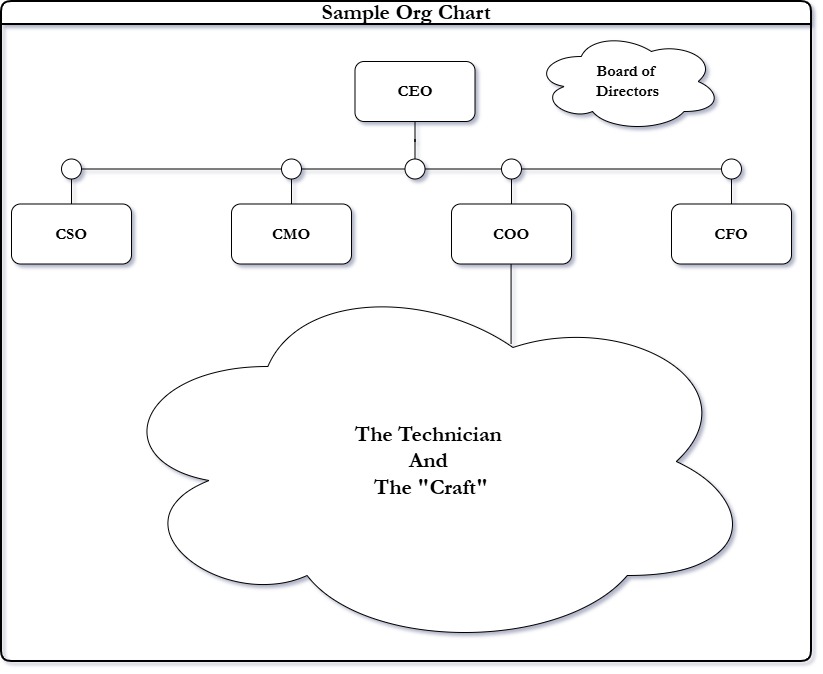
The first one is an Organizational Chart and this shows the key roles in just about any business.
Technician and The Craft
At the bottom (the big bubble) you have the technician and the craft. This is the work that you do that customers pay you money for.
This is where a lot of your time goes because these are your “billable hours.” Whenever you’re doing an hour of work here you’re probably charging the customer for an hour and you’re making your money.
When you first start a business this is pretty much all that you really care about – doing the work and getting paid for it.
The C-Suite
As you develop and start to wear more hats what do those look like?
I’ve outlined those here.
You have the
- CSO – Chief Sales Officer
- CMO – Chief Marketing Officer
- COO – Chief Operations Officer
- CFO – Chief Financial Officer
- CEO – Chief Executive Officer (the one who directs everything)
You also have off to the side the “Board of Directors” which includes mentorship and support.
Use this as a framework initially to think about what you’re doing in the business and splitting your time spent up into different roles.
Saying “I am doing the work of the CEO right now” and then taking that hat off and saying “I am doing the work of the CFO right now” and taking that off can help you differentiate.
Pro-Tip: You’re never really wearing two hats at once! It’s one hat at a time swiped out in really, really fast succession.
These are the initial landmarks that we’re looking for.
Job Duties For Each C-Suite Role
If you’re not familiar with this concept the Job Duties for each C-Suite Role can be like speaking Greek.
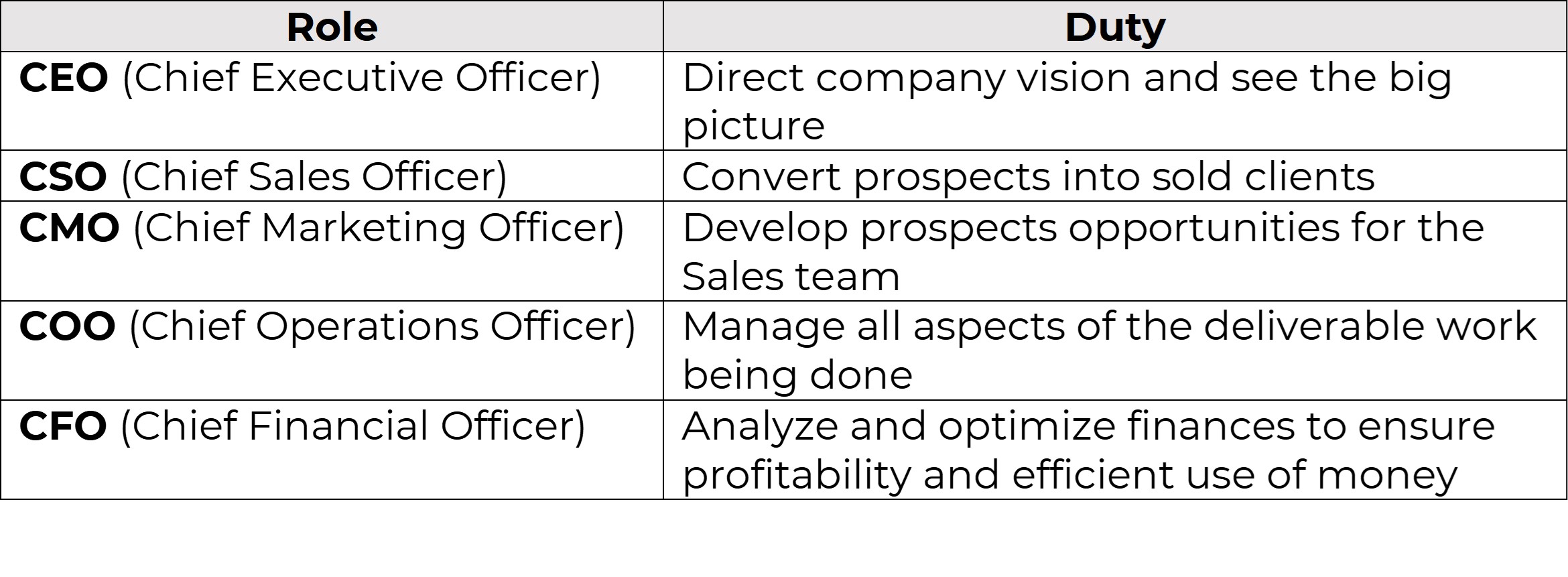
I’m going to break it down more clearly what each of those roles actually does.
CEO
The Chief Executive Officer is the person at the very top of the Organizational Chart.
They are the one that has the big vision and sees the big picture.
They steer the ship and they’re direct all of the other activities.
CSO
Below them on the Org Chart, you have your Chief Sales Officer who are the ones that close sales.
Once they have a prospect their job is to convert that person to a paying client.
CMO
The Chief Marketing Officer finds the prospects and leads for sales to talk to whether that’s through social media marketing, cold calling, creating brochures, networking, or other methods.
There are lots of ways that marketing might do its job!
COO
The Chief Operations Officer manages all the aspects of the deliverable work.
This may include things like managing inventory, building out systems and processes, and keeping equipment running smoothly.
There are a lot of things that they do integrated to actually delivering of the craft by the technician.
CFO
The Chief Financial Officer is the one that analyzes and optimizes finances to make sure that there’s profitability and that money is being used efficiently.
The Problem For The Entrepreneur – No Initial Guidance
With all of these pieces going strongly the business has a very high chance of success.
But oftentimes an owner has strengths in one area and NOT another area and certain elements become neglected.
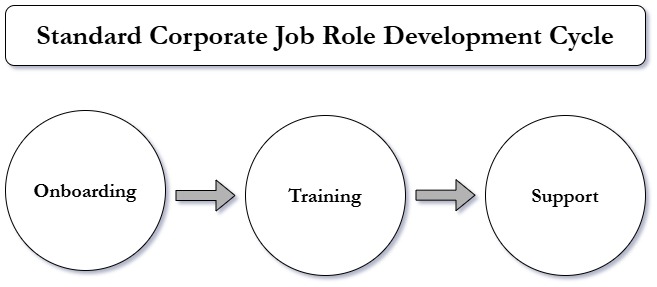
If you were joining a large corporate entity and let’s say you became the CFO at that job, you probably would initially go through a specific onboarding process that you just don’t get as a small business owner.
If you joined a big business you’d have this initial onboarding.
They’d say “Hey welcome to your first day. Here is your office. Here are your credentials to log into things.”
They would have ongoing training of “Okay and here is how you go in and do your actual job” over a period of you know three or six months.
They might break down every aspect of how to do what you do.
Then you would have ongoing support.
If you got stuck you’d be able to ask questions.
The Entrepreneur Experience With Mastering The Many Hats
So how does this become a problem in a business that you run?
Well as a small business owner (as you know) you just hung out your shingle started doing work and figured this out as you went along which means you have kinds of giant gaps in your knowledge.
What I frequently see is whenever you look at the Org Chart overall there are certain areas that people have natural strengths in. These are areas where they excel and they can do very, very well.
There are also areas where they just have no idea how to even start and they totally avoid those areas.
Here is where they tend to run into problems in their business!
We all have natural strengths and weaknesses.
Understanding Natural Strengths and Weaknesses
For example someone might be a visionary or a dreamer which increases the chances they’re probably not as good at laying out a project management plan and executing it. They like to think about the big picture and not so much the individual details.
The flip side is that detail person probably is really good at doing step by step by step work but not looking ahead to the future and dreaming big to make sure they’re going in the right direction.
There are also people who don’t mind talking to strangers and dealing with chaos of conversations. They can be very good at the sales side of things but again they tend to not be so much focused on the smaller detailed pieces that an operations director with SOPs might be good at.
No matter what skills you have there’ll be areas on this Organizational Chart that you naturally gravitate towards. You will do really well in areas that you feel very uncomfortable in.
To have a successful business you need to keep fleshing out success in ALL of these areas.
(I’ve talked before, but one of the biggest myths is just hiring for what you’re bad at.
You have to EARN that right by mastering the duty yourself and then when you hire somebody you can evaluate their performance over time.) So this is a place you can’t skip. This is a step you need to go through and focus on getting better at each of these individual duties over time.

Board Of Directors
Without this normal onboarding process that we talked about before where someone teaches you how to do step by step, you’re really left to figure it out on your own and that’s where the Board of Directors process comes into play.
If you don’t know how you to do something you have to either sit and think for yourself how to do it better with a pen, paper, and your own brain.
Or you have to bring in outside sources –
- searching things on Google,
- YouTube videos (like this one),
- podcasts,
- asking friends,
- asking family,
- asking other business owners,
- and more.
Whatever this looks like you have to get additional information to further improve your skills in these various areas.
The more that you do that, the more robust your business becomes and the easier it is to manage.
Toolboxes
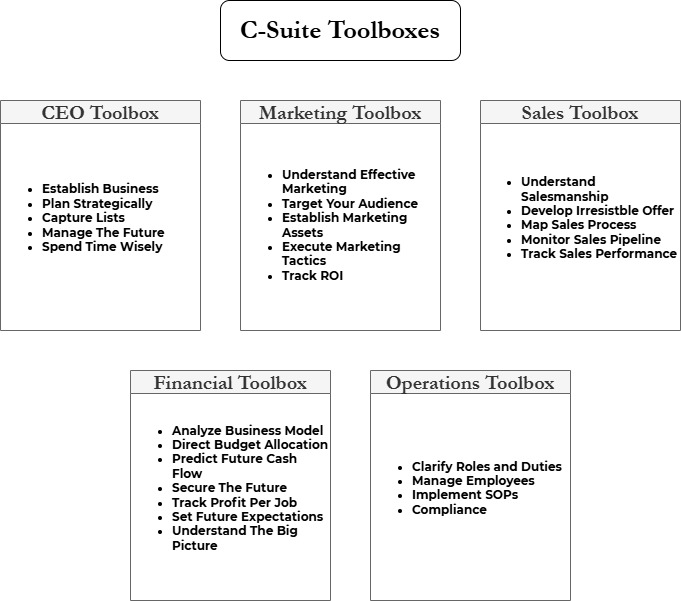
One way that I’ve helped facilitate gaining these skills for the people that work with me is a set of toolboxes I have built out. (This is not the purpose of this post so I won’t go into too much depth).
If someone is trying to master the basics of being a CEO there are a couple of key skills and there are the down and dirty tools and exercises to be able to master those.
The same is true with Marketing, Sales, Finances and Operations.
I’ve broken it down NOT with the goal of knowing everything there is to know but just the quick and dirty basics that apply to most businesses to get things up and running smoothly.
If you have a weakness area you can reach out to me, we can talk about adding these tools to your toolbox, but again not the purpose of this video so much as helping you look everything over on a bigger picture scale.
How Much Time Are You Spending Wearing Each Hat?
So what does this all mean?
We have these various roles and it’s important you may recognize when I’m doing a job who is doing that job.
- Is it the CFO doing this job?
- Is this the Marketing department doing this job?
- Is this Sales?
- Is this the Operations department?
- Is this a CEO job?
Recognizing when you’re switching those hats helps you down the road if you do expand and grow and actually hire people to know where the Sales role starts and stops and where Marketing starts and stops.
Clarity with the CEO job ensures you’re not expecting too much out of somebody elsewhere in the C-Suite (i.e. asking them to do CEO tasks) and you’re also not overlapping duties too much either (doing work that should be theirs to perform).
Analyzing The Time In Each Hat
The next step once you’ve identified these various hats is to ask “How much time am I actually spending wearing each of these hats?”
This is where it gets really interesting!
I’ve done this exercise with dozens and dozens of business owners.
It’s very frequent that I have someone who’s doing half a million dollars plus per year and when we talk through these different job roles they recognize
“Do you know what this role hasn’t clocked into my business in a year!?!?!”
“The CFO hasn’t clocked in since I did my taxes last year!”
“The Chief Sales Officer hasn’t clocked in for the past six months. I hate doing sales activities even though I know that I should.”
This becomes kind of a wake-up call to know where are there weaknesses!
If there are some efficiencies added it would get easier to do things within the entrepreneurs own style and be successful.
Business Role Analysis Tool
I’ve added a downloadable tool to help really analyze where your time is going currently.
It is a quick and dirty tool to do a speedy analysis.
Here is a quick walkthrough of how to use it.
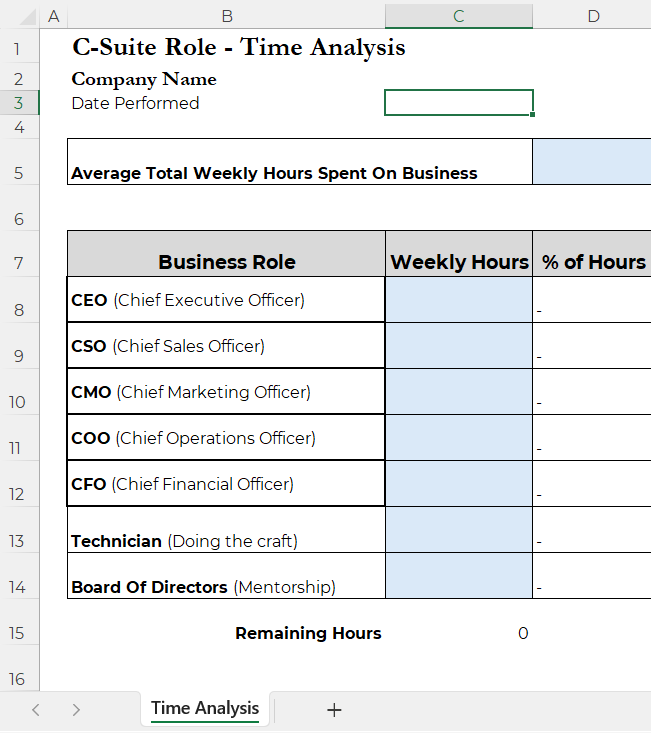
You can say “How many hours a week roughly am I working right now?” (It is not uncommon for an early stage business owner to be working you know 60 or 70 hours)
Out of that weekly average hours how much of that time am I spending doing each of the other roles?
- CEO work – Maybe one hour of really thinking through things.
- Sales – maybe I’m doing you know five hours a week.
- Marketing – maybe I’m doing four hours a week.
- Operations – maybe I’m spending about three hours on getting operations going smoothly.
- CFO work – maybe an hour
- Technician – maybe let’s say 35 per week.
- Board of Directors – 11 hours (reading books, listening to podcasts..)
You can see at the bottom a quick tabulator so you can see how many remaining hours left you have to allocate.
You start to get an accurate picture with some insights.
“Wow I can maybe spend some more time in this Operations role to make it so that the technician role gets easier to do.”
Or the CFO isn’t doing much work and if it’s not efficient “I don’t know what’s happening in my business. Maybe this is a giant problem area that I am avoiding or maybe it’s running smoothly.”
Or “I’m consuming a lot of content but not actually applying it to my business maybe I should re-evaluate my Board of Directors time?”
There are lots of outcomes and analysis that can come out of this but it gives you a real bird’s eye view with a black and white judgment of what’s happening in your business to take things to that next level.
Conclusion
As we review what we covered today the idea is that in your business you wear lots of hats.
Those hats are specifically
- the Technician
- the Chief Sales Officer
- the Chief Marketing Officer
- the Chief Operations Officer
- the Chief Financial Officer
- the Chief Executive Officer
- and the Board of Directors
To the degree of which you juggle between these hats and can do all of the hats well will show your degree of success.
The degree that you end up NOT developing skills in one of these areas will be the limiting factor that stops future growth.
This is a useful framework for thinking about how to develop and improve your skills.
If you have any questions let me know.
I hope this gives you a more solid framework as you’re thinking about
- which hat you’re wearing,
- when and how to juggle those duties,
- where you have opportunities to continue to grow,
- and where you have some strengths you should really applaud yourself for.
Best of luck have a great rest of your day!
Thank you very much for letting me be a part of your journey.
You must be logged in to post a comment.