
What exactly does the Chief Sales Officer (CSO) do in an organization?
As a reminder, we’re going over the multiple hats a business owner wears, even if it’s a one-person operation, they’re shuffling between these different hats: the CEO, CSO, CMO, CFO, COO, all the C-suite titles.
Today we’re focusing on the CSO, the Chief Sales Officer role.
If you have a one-person business, all of these duties fall on you.
If you have a larger organization, you may have someone else doing this work.
I find oftentimes in a smaller business, someone has mastered their craft, but they’re not clear on how to wear these other hats.
How To Be An Excellent CSO In Your Business
What types of duties should a Chief Sales Officer typically hold?
There are three main things that we’re going to focus on today.
- Understand what the stages of the sales process are in your business and how you manage each stage correctly.
- Manage a sales pipeline and how you manage customers through that process.
- Track your interactions so you can optimize and dial everything in.
The Stages Of The Sales Process.
If every single time you go into a sales conversation, it’s totally fresh and improvised, that means that you’re having to adapt to a lot of processing on the spot to figure things out. If you have a large organization, and you have salespeople, then you’re relying on their talent and not some proven roadmap.
Instead, it’s very helpful to give a framework to this and to label each of these stages.
Within each of the stages, there are some key things that tend to happen.
How do we maximize this for our exact use case, for our product, and for our customer interactions?
Maximizing comes in the form of clarifying the stages of the sales process.
I’ll share a brief worksheet visual here.
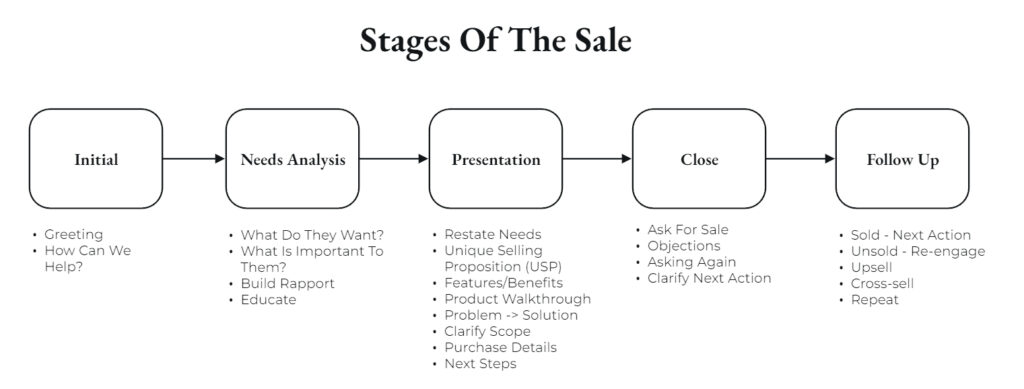
This is how I view the stages of the sales process in 90% of all businesses. You go through each of these stages.
Initial
This is where you have some greeting, and you’re building some general basic rapport.
Needs Analysis
This is one that can mistakenly be skipped over often.
- What does your client actually care about?
- What are they looking for?
- What’s important?
- What problem are they trying to solve?
Presentation
- How does our offering actually help and assist with their problem?
- And why should they choose us versus somebody else and all the benefits of what we offer?
Close
Now we’re ready to close and ask for the sale and overcome any objections that might come up that we missed in our presentation or needs analysis process.
Follow Up
Then finally, there’s follow-up; whether they bought or didn’t buy, there can be a nurturing process or an ongoing handoff to delivery process that needs to happen.
Putting A Clear Sales Process In Place
Even though these stages are fairly well defined and explained, for each business, HOW they are executed is going to be different.
It’s important that you map these details out with some clear ideas, because then you have each segment that can be optimized and built out.
It is the CSO role who should develop this clarity.
Oftentimes, as a starting place in a smaller business, they can be developed from scratch by going out and just trying to sell, and then coming back and documenting the successful best practices for each stage as they are discovered.
- What types of questions do we ask at the needs analysis?
- How do we capture that information?
- What’s our presentation?
- What’s our unique value proposition that we offer?
All those are the internal work the CSO needs to be performing so they can have salespeople do it, or again, they themselves can have the best results.

Pro Tip For Starting A Sales Team
If you are an owner doing the sales and you start to grow and want to have someone else do them later, that other person has a major disadvantage.
The owner always has the strongest opportunity because they have the most trust and authority with a customer. They’re the top tier.
A subordinate salesperson maybe could be suspected by customers to not be as straightforward or honest.
The owner is typically viewed as someone who is the last stop, and a customer is more likely to pay more attention.
Your salesperson could say something that doesn’t seem to go over well, but you, as the Chief Sales Officer, or as the owner, say the same thing, and the buyer listens to you where they ignored the salesperson.
This is important to establish that sales done by others SHOULD be at a lower success rate than by you early on.
Normally at this stage the owner assumes a new salesperson has sales experience and will do better and underrates the importance of authority and credibility in sales and therefore has unreasonable expectations.

Develop A Sales Pipeline Process
Rarely do the stages of the sale all happen at a singular time. Very rarely do we get to do the initial greeting to needs analysis, presentation, and asking for the sale all at once.
Typically, that’s spread out across multiple steps. And if we only look for people that basically got on the train at stop A and got off at stop B, we would end up leaving a large amount of unserved clients.
We have to
- Chase them down
- Track them
- Follow them
- And keep them together
so that we can help them on the train station whenever they’re ready.
We do that by having a very clear sales pipeline.
It might look something like this in a conceptual framework to start with.
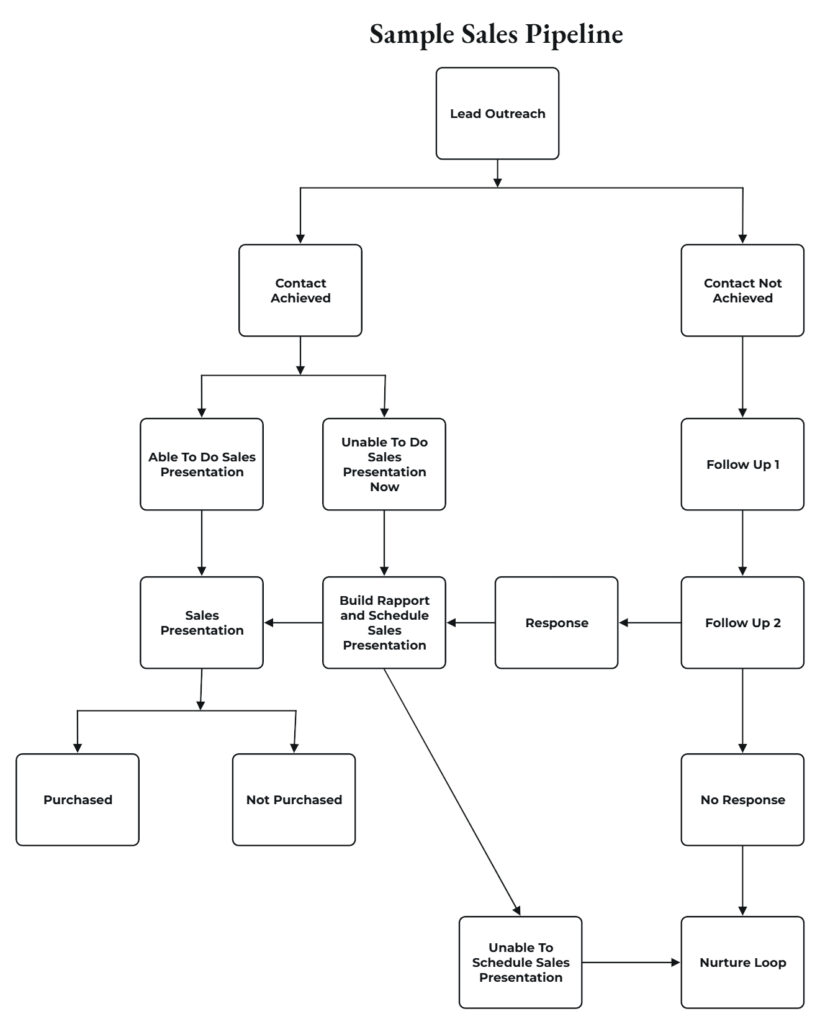
Someone does set up an initial call, or they don’t.
If they don’t, what should you do next?
If they do, what do they do next?
This maps out exactly how you behave in that situation all the way down.
From there, you also need a way to track specifically, you know, client Bob Smith, here’s his email or his phone number.
- Where is he at in the process?
- What’s the next step?
Without this tracking mechanism, you’re relying on just your brain. You’re going to let so many fall through the cracks just by not tracking or knowing what the next step is.
Or knowing how many times you reach out before you say, “This is no longer a valid lead. I will put them on the long-term nurture every six months. We’ll do an email and just check in, but I will assume that they have fallen off.”
What does that look like for your organization?
The CSO also maps that in a business.
What is the flow of how a customer comes through the business to get them into the stage of the sales process to move them through those steps?

Tracking Data To Optimize Sales
Depending on variables, this may be a straightforward process or it may be a little bit of rough math.
The goal is you’d like to have a general idea of to what degree your approaches are working when you’re talking to people.
- Are they moving forward and buying or not?
- Are they moving forward to an initial conversation, a needs analysis or not?
- Where are they falling off?
- What is on the step prior to when they fall off?
- Can you make changes to improve that?
Then you can use data to understand whether the numbers show that it actually has been improved by your changes or not?
We’re never looking for the one right answer here.
We’re trying to identify what’s the right tool for the right job.
So maybe customers in this type of a demographic fall off here, and how can we better suit their needs?
Where customers with this needs analysis profile tend to struggle getting to see the value of what we offer, how can we better present and relay that?
That becomes this ongoing process, this creative expression of the sales process, which is really, really fun.

Conclusion
These were the three key things the CSO focuses on
- The stages of the sale and how to optimize those.
- The pipeline of how customers move in and out of that process.
- Tracking to tweak and optimize the sales experience.
Selling Without Feeling Sleezy
It is NOT the job of sales, in my opinion, to ever put someone in a headlock and try to make them buy.
We’re never trying to be sleazy and convince people to buy what we have. We’re only educating buyers so that they have an educated position to make a decision from.
We do have a right to follow up and ask if they’re taking the next step as it benefits them until they tell us no, and then we happily leave them alone and try to help them find whatever solution is a good fit for them.
But we’re never trying to be pushy in the sales process.
So even though we’re tracking and optimizing, that’s more to check: are we doing a good job of educating and asking the right questions than are we actually twisting arms and forcing yeses?
Because whenever you follow the sales process in the right way,
- People are happy they did business with you.
- They refer people; they’re repeat customers.
- They don’t feel taken advantage of and dirty afterward.
A good Chief Sales Officer in an organization, again, whether it’s you or multiple people, is overseeing this process for a smooth process to explain what you do in a way that a customer can understand it and move forward to the next stage to enjoy the benefits of what you offer.
I hope that helps demystify one of these hats. We’ll keep going over the rest of them and throughout the rest of this series.
If you’d like some more content on the topic, Lead Generation and Sales – Business Skill #3 To Take Your Business To The Next Level is a good place to start.
Have a great day.
You must be logged in to post a comment.