
Hey there, high performers.
In today’s video, I will talk about one of the main hats an entrepreneur has to wear, which is that of being the CEO of their own business. (I’ve talked before about all the different hats that a business owner is wearing and having to juggle and the toolboxes I have to work on those, but I wanted to focus today on the CEO hat specifically.)
There are a few key duties of the CEO.
One of the most important is Strategic Planning.
The CEO is the one who has the vision and steers the ship in a certain direction.
Being able to provide strategic guidance for the business is incredibly important.
If YOU are not being the CEO and guiding your company, nobody else is! It’s just out there floating around without a rudder.
You’re the only person who can do the strategic planning work.
It’s possible you have employees doing other parts of the work, but they will NOT be envisioning where your business should be going.
That is definitely all on you, whether you’re a one-person business or a 30-person business.
I’ll break down the ideal components of what developing strategic guidance for your business as the CEO looks like.
There are three key elements of developing and executing a strategic plan that are the responsibility of the CEO.
- Know what you want
- Develop a plan
- Execute and monitor that plan
Know What You Want
I would say that number one, knowing what you want, is actually the most difficult of these, and it’s for a really unique reason.
Requirements to know what you want
- Space and time to think
- Inspiration
Space and Time to Think
It takes space and time and thinking to know what you want.
In many other areas of your business, just working harder and pushing and keeping the pace up can actually serve you very, very well.
But in this “knowing what you want” stage, one of the key requirements is actually having quiet, silence, space, and calmness (which is the opposite of this go, go, go you have all the time).
It’s so easy to stay in that go, go, go all the time mode and never sit back and think about what you actually want or where you’d like to head.
And if you keep just doing, you’ll never think about the bigger picture. You’ll instead stay in that technician role.
By default, to step up in the CEO role, you have to be able to put boundaries around your time and protect little blocks of time to sit and reflect.
This is out of the comfort zone for many entrepreneurs because their brains are always spinning.
- “If I could be talking to customers and getting a sale right now”
- “I could be doing the work and getting paid per hour.”
- “I could be doing the to-do list is so long, there’s no time. “
Carving aside and protecting the time for strategic planning is its own special skill to sit and reflect on what you actually want.

Inspiration
Another part of this, “knowing what you want,” is getting inspiration if you feel stuck.
In a previous video, I talked about the informal role of the board of directors as a provider in various areas of inspiration and mentorship for the CEO.
Again, this can be podcasts, books, other owners, or business consultants like myself.
There’s a wide variety of ways to get inspired!
Find something that can really jumpstart these thinking periods for you and help you stay focused on that.
Sometimes even having someone sitting next to you while you’re thinking through this strategic planning work can be helpful.
Maybe you’re talking it through with them.
Even if they’re just silent in the room with you while you have your pad and paper out and you’re writing down your strategic guidance goals, can be incredibly helpful.

Do You Know What You Want So You Can Provide Strategic Guidance?
So this “knowing what you want” as the CEO is very difficult because it takes time and space.
- Where do I want my company to go?
- What does that actually look like?
- What is important to me? (Not what are the values that other people say I should care about and should be important to me, but what actually matters to you?)
- Where do you actually want to go?
That’s the important part of this knowing.

Develop A Plan
Developing a strategic plan is key to getting it from the vision stage to a practical stage where you have something you can actually execute.
- Break it into steps
- Create a reference
Break It Down Into Steps
Take this vision of where you’re trying to go and chunk it up into actual individualized steps with clarity.
If you skip this step, you can never actually act on the plan.
Break it down, “step one and do this, and this includes A, B and C. Step two is this, which includes these items…”
You might not have all the details. That’s ok!
The more thorough the plan is, the more you can use the plan to execute and just stay in technician mode and get things checked off the list quickly.
So having that broken down list is very, very important to create an opportunity to actually execute on this plan that you have.

Create a Quick Reference
I highly recommend creating a reference of what your plan is.
If you develop this plan and it’s in your head or across a series of scratch papers, it can take a lot of time to get back into the mode where you understand and remember what the plan is because you get distracted and pulled in a million different directions.
Create a one to two page document that reminds you of what the plan is and what the order of tasks to be completed is.
This can be a great reference to jog your memory.
So when you step out of the busy everyday world of the business and you have a quick minute, you can look at your reference and instantly recognize, “Oh yes, I’m executing at this level at this stage right now” to stay on track for executing your plan.

Execute and Monitor Your Plan
The final part of this is executing and monitoring the plan.
So we took time to think about and know exactly what we wanted. We got inspired if we needed some more ideas.
We developed a plan with clear step-by-step actions and a reference that we can use to make sure we know where we are on the plan.
Now it’s time to actually execute the plan and monitor the plan.
Execute Your Strategic Plan
Executing is going to come down to actually making sure your strategic plan is a priority.
Again, it’s very easy to stay focused on surviving the day to day and not make bigger moves that plant seeds for a better future.
Typically, these CEO-level plans are what make it so that next month is better than this month, that next year is better than this year.
Without that, we’re on this stationary bike treadmill where each day is like the last.
To execute the plan, it is essential to make it your priority and to carve aside that time.
Monitor Your Strategic Plan
A part of executing your plan also includes evaluating how you are progressing.
It might be that the plan that the CEO sat and thought of is not one that can happen in the real world.
Maybe there are reasons that things need to be pivoted or adjusted. It’s running uphill. It’s not going to work.
Or in executing it, a whole new opportunity opened up where there’s a big chance to just really run after something you couldn’t have foreseen until you were in the acting stage.
So this monitoring and evaluating is vital to make sure that you take advantage of every opportunity, identify obstacles, and overcome them.

Gathering Information From The Rest of The C-Suite
The other part here of this executing and monitoring is that typically it’s going to involve pulling in information from the other C-suite hats.
(I’ve mentioned before if you’re a one-person business, you’re probably wearing all these hats. You’re probably also the CFO, CMO, COO, CSO…)
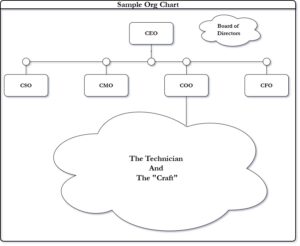
As the CEO, oftentimes you’re not doing this work in a vacuum.
You’re oftentimes bringing in (either metaphorically or in reality) the CFO for a part of your planning, the CMO, the CSO, the COO, and saying
- Hey, what type of systems and processes do we need to put together?
- What does the financial planning look like?
- What type of savings feels safe?
- Do we need to adjust pricing?
- How can we get more customers?
Basically you’re going to be bringing data from below you so that your strategic planning can be evaluated and you can make it all work.
And that involves orchestrating the specific changing of the hats.
Thinking of it in this way, even if you are the only person in your business, helps create a clearer, less confusing framework for decision-making.
CEO Duty: Providing Strategic Guidance
This has been a deep dive into one of the key roles in the CEO’s job duties: strategic guidance.
Hopefully this has given you a framework for beginning to think about what that might look like.
Again, if you want extra guidance from me, don’t hesitate to reach out.
If you want to figure out your own path forward, that is fine. My goal has been to offer clarity on the importance of the work here to be done.
Take your company in a conscious, chosen direction towards your dream future.
Best of luck to you. Have a great one!

You must be logged in to post a comment.